Brake Fluid Is the Boring Service That Matters (And Why It Matters More on a Hybrid)
Let’s be straight about this one.
Brake fluid changes are the easiest thing on a service invoice to dismiss as an “upsell.” The job is relatively quick for a specialist with the right kit, the fluid itself isn’t particularly expensive, and: here is the kicker: most customers will get back in the car after the service and feel exactly the same as they did before they handed over the keys.
When you see it on the bill at £50–£70, the question is perfectly fair: did that actually need doing, or is the garage just trying to pad the invoice?
At High Volt Garage, we get it. We’ve been on the other side of the counter, and we’ve seen the “menu pricing” structures that push these items regardless of whether the car needs them. So, let’s deal with that head-on. Most of the time, on most cars, if you skip a brake fluid change, you won’t notice a thing. You will drive around Peterlee for years, hit the brakes, the car will stop, and life goes on.
That is exactly why it gets ignored. But there is one specific scenario where boring brake fluid stops being boring and becomes the most important thing in your life. And if you’re driving a modern hybrid or electric vehicle (EV), the maths of safety changes completely.
What is brake fluid actually doing?
Brake fluid is the hydraulic link between your right foot and four metal calipers. Unlike the air in your tyres, fluid is (mostly) incompressible. When you push the pedal, that force is transmitted instantly through the lines to squeeze the pads onto the discs.
The catch is heat. Modern brakes generate a staggering amount of thermal energy. If you’re driving a heavy Audi Q7 or a VW Touareg, stopping two-and-a-half tonnes of German engineering from motorway speeds turns motion into heat very, very quickly. The fluid has to stay liquid through all of that. The moment it boils, you have a problem. Gas compresses; liquid doesn’t. If your fluid turns to gas, your brake pedal goes to the floor.

Here is the bit that rarely gets explained: brake fluid is hygroscopic. This is a fancy way of saying it acts like a sponge for moisture. It absorbs water directly out of the atmosphere through the rubber seals and microscopic vents in the reservoir cap. There is no way to stop it.
Manufacturers know this, which is why the VAG service schedule (Volkswagen, Audi, SEAT, Škoda) usually calls for a change every two years.
To put numbers on it: “Dry” brake fluid (fresh out of the bottle) boils at around 230–260°C. Once it has absorbed just 3% water, that boiling point can drop to 150°C. That is a massive 100°C safety margin gone. In a heavy car on a hot day, that difference is the gap between stopping safely and sailing through a junction.
The one scenario where it bites: The A19 Effect
We see this a lot with cars that come into our Peterlee workshop. The owner says the brakes feel fine “normally,” but they had a “moment” on a long trip.
Picture this: You’re on the A19 northbound, fast lane, four people in the car and a boot full of luggage. Traffic is moving at 70mph, and suddenly the car in front jumps on the brakes (usually around Easington services) You stamp on yours. The car stops fine. The pedal feels firm, and you breathe a sigh of relief.
Two minutes later you’re at the A690 Durham turn off, the traffic bunches up and it happens again. You grab the pedal a second time, but this time, it’s gone. It feels long, soft, and travels halfway to the floor before you feel any bite. Your stomach drops because, for half a second, you genuinely think you aren’t going to stop.
That is brake fade caused by water. The first hard stop heated the fluid up. Because the fluid was contaminated with water, that heat caused the moisture to turn into steam bubbles inside the lines. On the second stop, you weren’t pushing fluid; you were trying to compress steam.
It’s a rare scenario in everyday town driving around County Durham, but it is the scenario that matters most. The cost of changing the fluid every couple of years is tiny compared to the consequence of a brake pedal that fails when you’re doing 60mph toward a stationary lorry.
Why hybrids and EVs change the rules
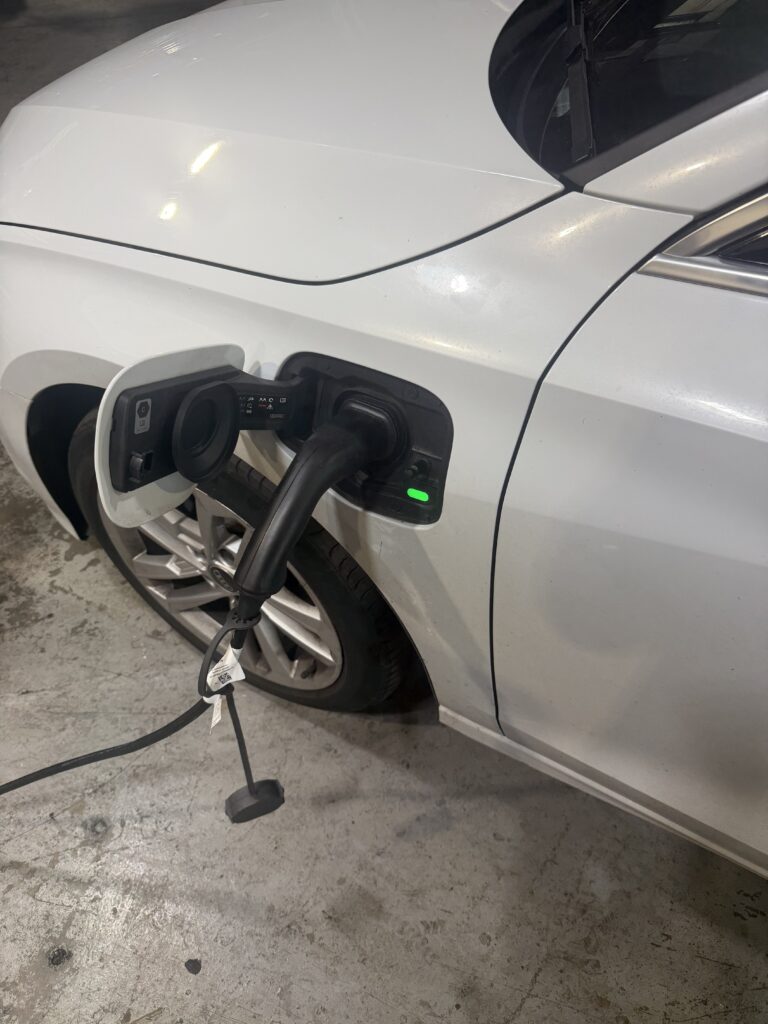
If you are driving a Golf GTE, an Audi e-tron, or a CUPRA Born, you might think your brakes are having an easy life. In many ways, they are.
These vehicles use regenerative braking. When you lift off the accelerator or touch the brake pedal lightly, the electric motor reverses its role to act as a generator, slowing the car down and putting energy back into the battery. The actual friction brakes: the metal discs and pads: hardly do any work in normal traffic.
On the surface, this sounds great. Your pads might last 80,000 miles. But for the brake fluid, this creates a “silent” failure mode.

In a traditional petrol or diesel car, the heat from regular braking helps to dissipate some of the moisture around the calipers. In a hybrid or EV, the system stays cold. The fluid sits there, stagnant and cold, absorbing moisture for years while the owner thinks everything is fine because the pads still look brand new.
There are two major risks here:
- The Emergency Scenario: Because the friction brakes are rarely used, you only really call on them when you really need them: an emergency stop or when the battery is 100% full and can’t accept any more regen energy (like coming down a long hill). If the fluid is wet and the system is cold-soaked, you are asking for 100% performance from a system that hasn’t been “exercised” or maintained.
- Seized Hardware: We are seeing more and more EVs and hybrids coming into the garage with seized brake calipers. Because the pistons aren’t moving through their full range of travel frequently, and because moisture is sitting in the fluid near the caliper, internal corrosion sets in.
We’ve seen three-year-old electric cars with perfectly thick brake pads that are effectively useless because the calipers have seized solid from lack of use and old fluid.
The VAG Specialist approach: DOT 4 vs. DOT 5.1
In the Volkswagen-Audi Group world, the type of fluid matters. Most modern VAG vehicles require a low-viscosity DOT 4 fluid. However, for some of the higher-performance hybrids and EVs, the requirements are even tighter.

When we perform a brake fluid service at High Volt Garage, we aren’t just pouring in whatever is on the shelf. We use high-quality fluids that meet or exceed the manufacturer’s specification (VW 501 14). This is especially important for cars equipped with advanced ESP (Electronic Stability Programme) and ABS systems. These systems use tiny valves that pulse dozens of times per second; if the fluid is too thick or contaminated with “sludge” from moisture, the safety systems can’t react as quickly as they were designed to.
How we handle it at High Volt Garage
We don’t believe in “guessing” your maintenance. If you bring your car to us in Peterlee for a service, we don’t just tick the brake fluid box because the clock says it’s been two years.
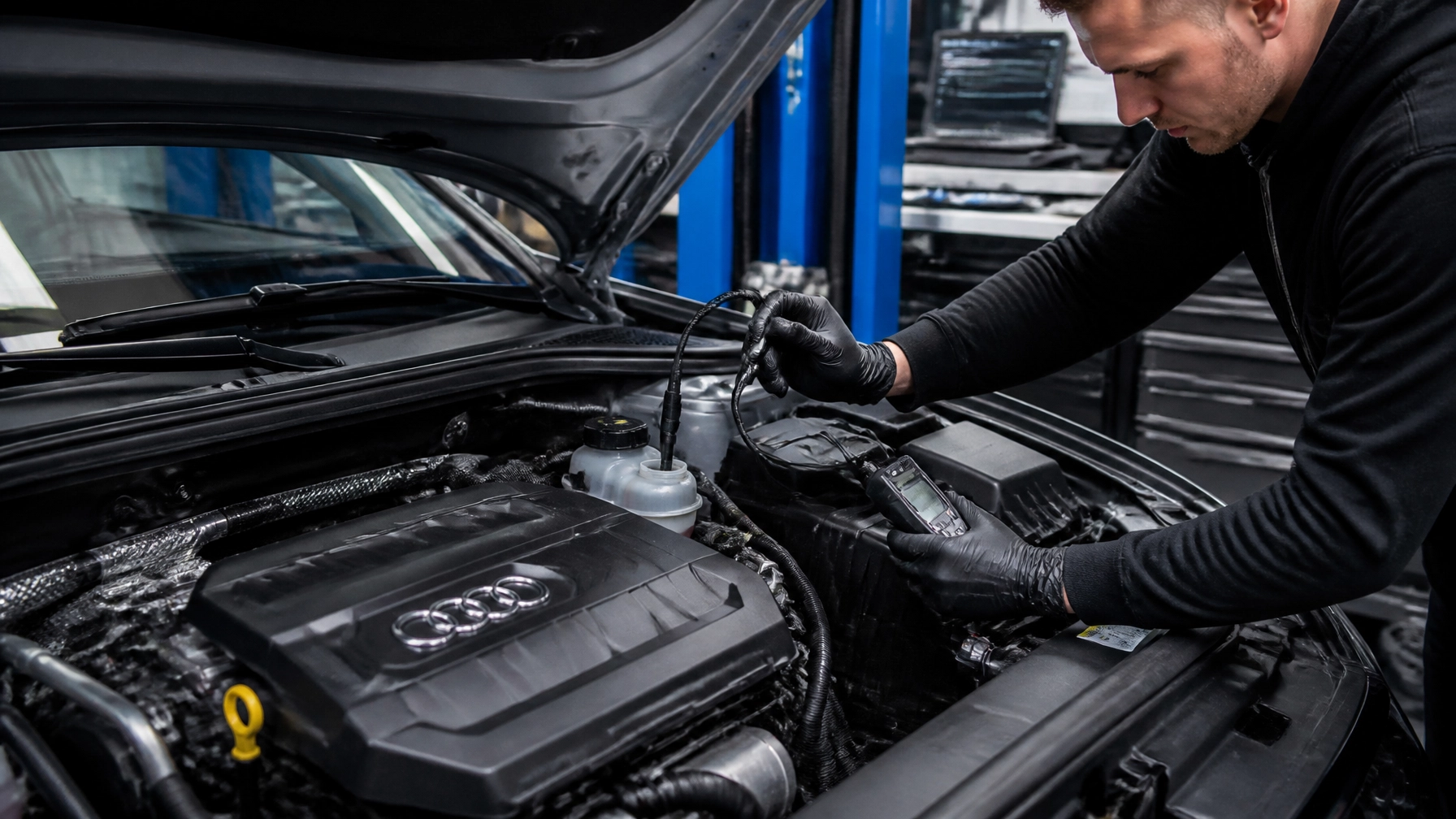
We use a professional moisture-content tester. This tool measures the boiling point of the fluid currently in your reservoir.
- If it’s dry: We will tell you. We’ll note the reading and suggest you save your money for another year.
- If it’s borderline: We’ll show you the reading and let you decide, usually recommending a change if you have a long trip or a holiday planned.
- If it’s “wet” (over 3% moisture): We will recommend a change immediately.
When we do the job, we use a pressure bleeder. This ensures that the old, contaminated fluid is pushed out of the entire system: including the ABS pump and the furthest corners of the brake lines: and replaced with fresh, high-performance fluid. We don’t just suck the fluid out of the reservoir and call it a day (a common shortcut in some “fast-fit” centres).

The bottom line
Brake fluid isn’t about how your car feels on the way to the shops. It’s about how your car behaves in the one second that defines whether you have an accident or a “close shave.”
On a hybrid or EV, the stakes are slightly higher because the system doesn’t give you the warning signs (like squealing pads or thinning discs) that a petrol car might. The fluid is the heart of the system, and it’s the one part that degrades even when the car is sitting on your drive.
If you haven’t had your brake fluid tested in the last two years, or if you’ve recently bought a used hybrid and aren’t sure of its history, it’s worth getting it checked. It’s a small price to pay for the certainty that when you hit the pedal, the physics will work in your favour.
If you’re concerned about your brakes or your service light has come on, get in touch. We specialise in VW, Audi, SEAT, Škoda, and CUPRA, and we have the specific diagnostic tools required to bleed even the most complex hybrid braking systems correctly.