Diesel Bug in VW Transporters and Campers: What It Is, How to Spot It, and How to Stop It
If your VW Transporter or campervan spends more time on the driveway than on the road, you may be hosting an unwanted guest in your fuel tank. If your van sits for weeks between trips, or only does a few thousand miles a year, you are in the highest-risk group for diesel bug contamination. It is one of the most common fuel-related faults we see on low-mileage VW T5, T6, and T6.1 models at High Volt Garage. Unfortunately, it almost always announces itself at the worst possible moment: usually when you are loaded up with the family and halfway to the Lake District.
The good news is that diesel bug is entirely preventable. If caught early, it is relatively cheap to deal with. However, if left alone, it can lead to some of the most expensive repair bills a modern diesel owner can face.
What is diesel bug?
Diesel bug is the common name for microbial contamination in diesel fuel. It is not a single organism but a cocktail of bacteria, yeasts, and fungi: the most common being Hormoconis resinae. These microbes live and grow at the boundary between water and diesel inside your fuel tank. They feed on the hydrocarbons in the fuel and produce a thick, black or brown slime that looks remarkably like wet coffee grounds or dark jelly.
Two factors have made this problem significantly worse over the last decade. First, modern diesel (B7) contains a percentage of biofuel, known as FAME (Fatty Acid Methyl Ester). While better for the environment, FAME is hygroscopic, meaning it absorbs and holds water far more readily than the old mineral diesel. Second, low-sulphur formulations removed one of the natural inhibitors that used to keep microbial growth in check.
Put those two together and modern pump diesel is, frankly, a much better environment for bugs than it used to be. When water enters the tank: usually through condensation: it settles at the bottom because it is heavier than fuel. The “bug” sets up home exactly where the water meets the diesel, feeding on the fuel and multiplying rapidly.

Why Transporters and campers are particularly at risk
A daily driver that gets filled and emptied every week doesn’t give the bug much chance to establish. The fuel turns over too quickly for a significant colony to grow. VW Transporters and camper conversions are different. A camper that does a few weekends in the summer and then sits parked from October to April is the perfect host.
There are several reasons why your van is at higher risk:
- Long static periods: Fuel that sits for months begins to stratify. Water settles at the bottom of the tank, right where the fuel pickup is located, providing the perfect habitat for microbial growth.
- Temperature swings: In County Durham, we see significant day-to-night temperature changes. As the air in a half-empty tank cools and warms, it cycles in and out, depositing moisture via condensation every time.
- Low annual mileage: If you are only doing 3,000 miles a year, the same fuel can sit in the tank for six months or more. That is plenty of time for a small contamination to become a major infestation.
- Half-full tanks: Most owners don’t store their van brimmed. A half-full tank has a large volume of air, which leads to more condensation and more water for the bug to thrive in.
If that sounds like your van, you aren’t doing anything wrong: it is just the nature of how campers and hobby vans get used. But it does mean that prevention needs to be a deliberate part of your maintenance routine.

Symptoms: how to tell if you’ve got diesel bug
The early signs of diesel bug are often easy to miss or can be written off as a “one-off” glitch. However, there are very clear indicators we look for in our Peterlee workshop:
- Hard starting: If the van struggles to fire up, especially after it has been sitting for a few days, it may be because the fuel pickup is struggling to pull through the thick slime at the bottom of the tank.
- Loss of power under load: The van might feel “flat” when you are going up hills or trying to pull up to motorway speeds. This is often caused by a partially blocked fuel filter restricting flow.
- Engine cutting out: You might experience the engine cutting out unexpectedly, often when you slow down for a junction or at low revs.
- Black smoke: While less common on modern DPF-equipped vans, heavy contamination can sometimes lead to visible exhaust issues.
- Frequent filter blockages: If a fresh fuel filter solves your running issues for a couple of weeks but then the symptoms return, that is diesel bug until proven otherwise. The contamination is still in the tank, and it is simply clogging your brand-new filter all over again.
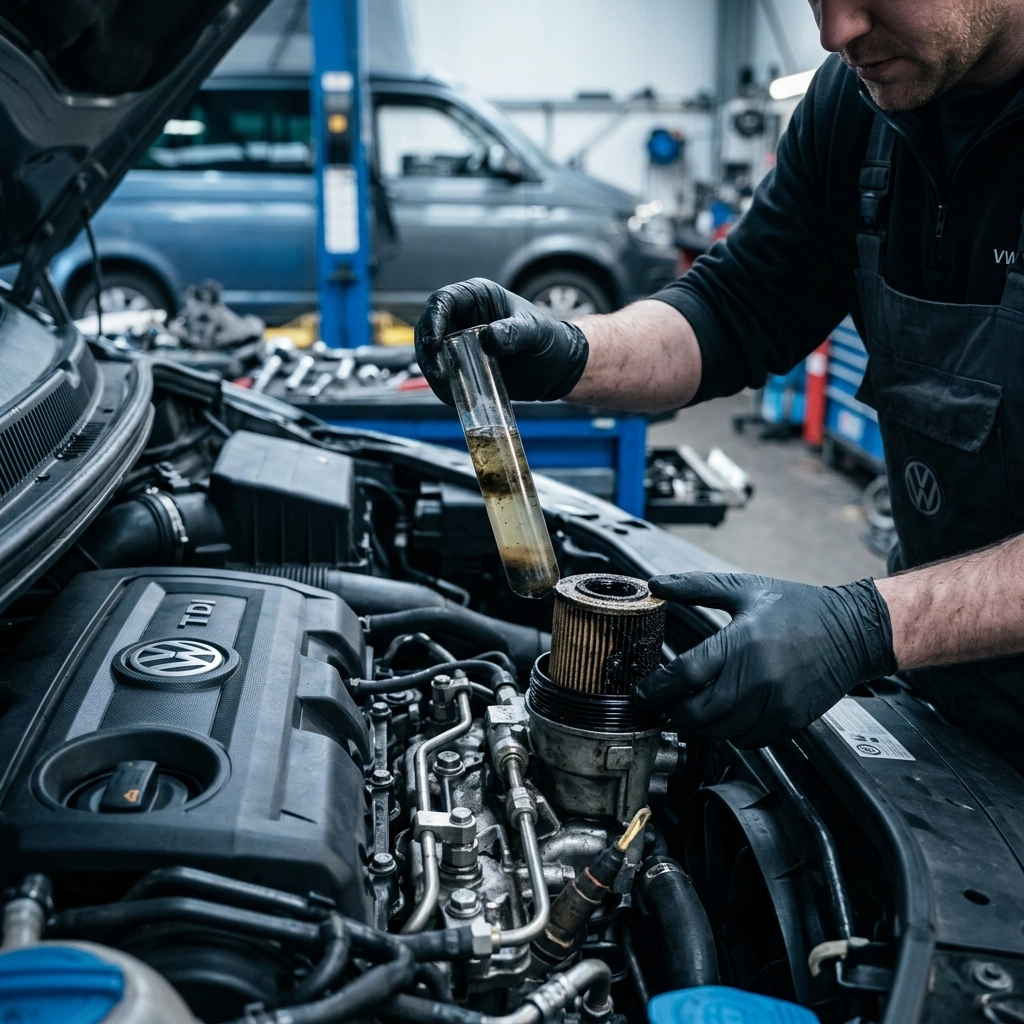
When we suspect diesel bug, we often cut the fuel filter open. If the internal paper element is covered in black, slimy residue, it is a definitive sign of microbial growth.

The expensive reality of ignoring contamination
This is where the situation moves from a nuisance to a financial headache. The bug doesn’t just sit politely in the tank. As the microbes grow and die, they produce acidic by-products. This acidity, combined with the physical sludge, wreaks havoc on the precision-engineered components of a modern VW common-rail diesel system.
The acidic sludge can corrode fuel tank linings, lift pumps, and fuel lines. Even worse, if the contamination passes through the filter, it reaches the high-pressure fuel pump and the injectors. On a modern T6, an injector replacement on its own can easily run into four figures. If the high-pressure fuel pump fails due to lack of lubrication or debris, it can “grenade,” sending metal particles through the entire fuel system. At that point, you aren’t just looking at a tank clean; you are looking at a total fuel system replacement.
Catching it early: through filter checks, biocide treatment, and system cleaning: is a small fraction of the cost of dealing with the downstream consequences.
How we deal with it at High Volt Garage
When a Transporter comes into High Volt Garage with suspected diesel bug, we follow a professional, technical process to ensure the problem is solved properly. We don’t just pour an additive in and hope for the best.
- Filter Inspection: We inspect the fuel filter first. As mentioned, cutting it open provides immediate visual evidence of the level of contamination.
- Fuel Sampling: We take a sample from the bottom of the tank. This allows us to confirm the presence of water and see exactly how much “sludge” is currently sitting in the system.
- Professional Biocide Treatment: Not all fuel additives are the same. Many “fuel cleaners” found in high-street shops are simply cetane boosters or basic detergents. We use professional-grade biocides that are specifically designed to kill the microbes. This stops the growth and breaks down the sludge.
- System Cleaning: Depending on the severity, we may need to drain the tank, clean it manually, and flush the fuel lines.
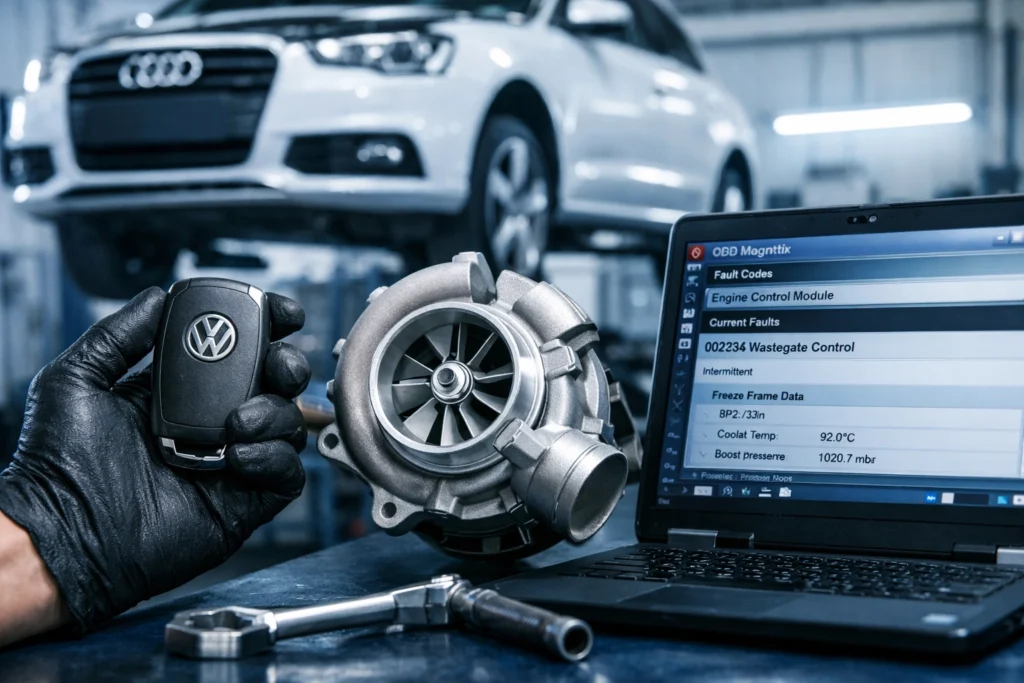
- VAG-Specific Diagnostics: Using ODIS (the same diagnostic software used by VW dealers), we can look at live fuel pressure data and injector behaviour. This allows us to confirm that the contamination hasn’t already caused permanent damage to the high-pressure side of the engine.

How to prevent it coming back
Once the system is clean, the goal is to keep it that way. This is mostly about changing your storage habits, especially during the winter months.
- Brim the tank: Before laying the van up for more than a few weeks, fill it to the brim. Less airspace in the tank means less room for condensation to form. This is the single most effective thing you can do to prevent diesel bug.
- Use a maintenance dose: If you know the van is going to sit, use a high-quality fuel stabiliser or a maintenance dose of biocide. It is cheap insurance against a very expensive problem.
- Stable temperatures: If possible, store the van somewhere with stable temperatures. While a garage is ideal, even a covered carport can reduce the extreme day/night temperature swings that drive condensation.
- Run the van properly: Short five-minute trips to “keep the battery charged” can actually do more harm than good. They don’t get the fuel system warm enough to drive off moisture. When you use the van, give it a proper run.
- Stick to the schedule: Replace your fuel filter at every service. If your van is low-mileage, time matters more than miles. Don’t wait three years just because you’ve only done 5,000 miles.
Get your Transporter checked
If your Transporter or camper has shown any of the symptoms we’ve mentioned, or if it has been sitting idle over the winter and you are planning your first trip of the season, it is worth getting it checked before you head off.
At High Volt Garage, we can inspect your fuel system, sample the fuel, and give you a clear picture of its health. We focus on technical accuracy and straight advice. If your fuel is clean, we will tell you. If it isn’t, we will show you what we found and explain the best way to fix it properly.
High Volt Garage
16 Pease Road, Northwest Industrial Estate, Peterlee, County Durham, SR8 2RD
Mon–Thu, 08:30–18:30
01915 864148 | Sales@highvoltgarage.com |